
Published October 28, 2026
Telehealth Psychiatry New York: 2026 Guide for Inwood, Manhattan Residents
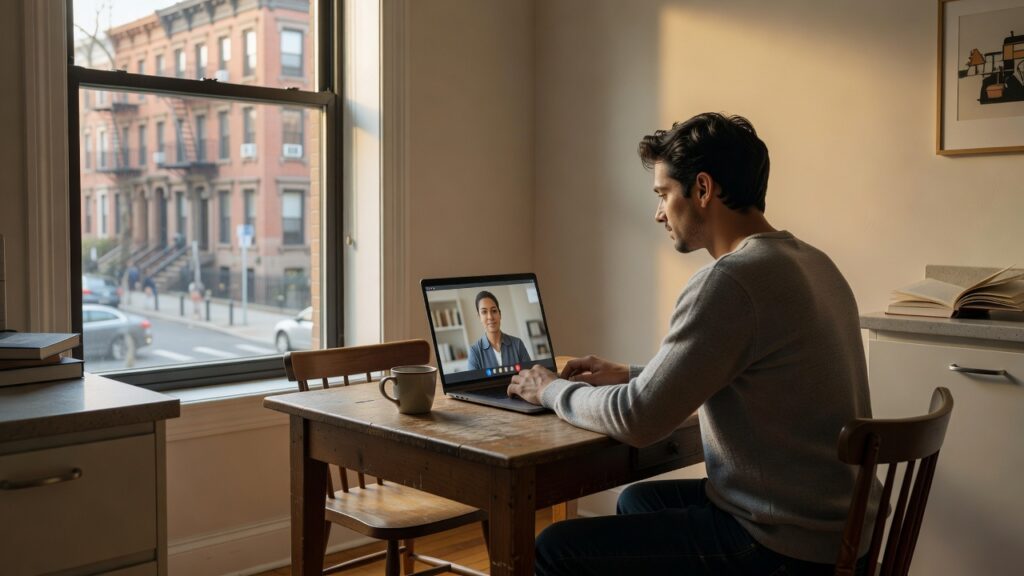
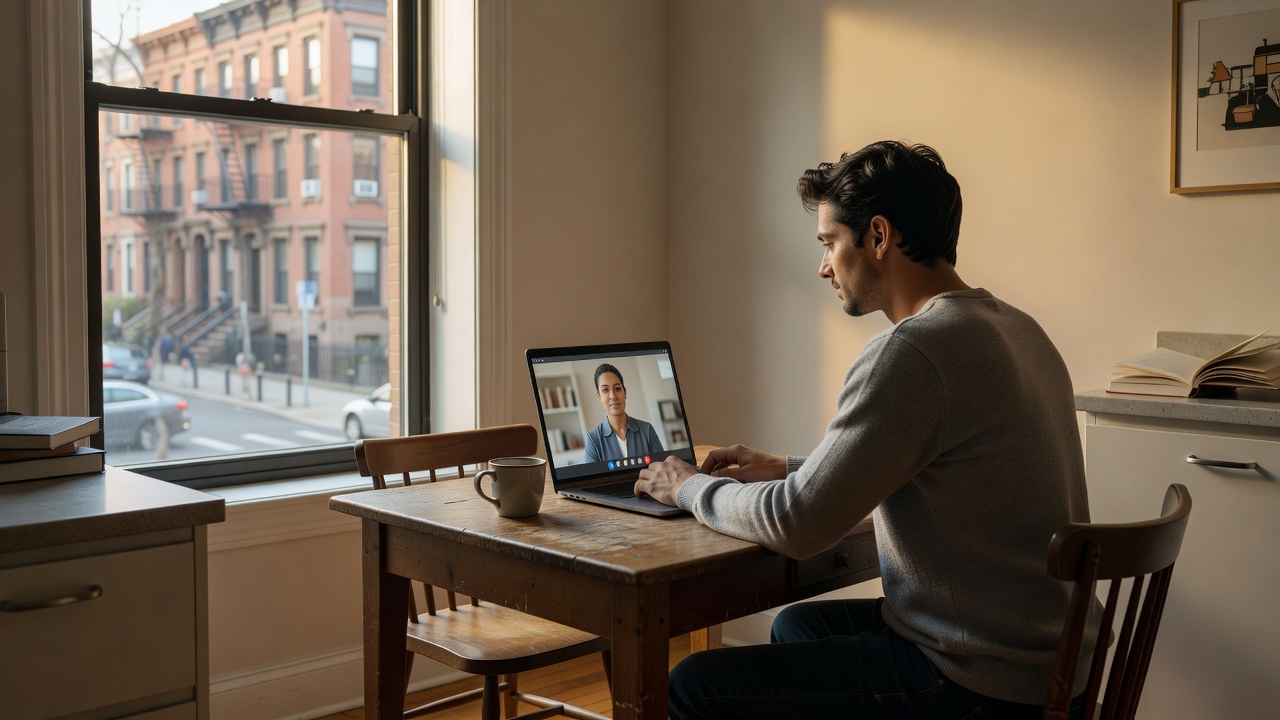
Telehealth psychiatry in New York lets you meet with a licensed psychiatric provider by video or phone from any private space in your home. Most appointments last 30 to 60 minutes, can be scheduled within days rather than weeks, and are covered by Medicaid and many commercial plans. For Inwood residents juggling the A-train commute or caretaking responsibilities, that access matters.
A common assumption is that telehealth psychiatry is a lesser substitute for in-person care. That’s not the experience our New York clinical team observes. The American Psychiatric Association reports that 75% of people with mental illness do not seek treatment, and the barrier is almost never clinical quality. It’s logistics: parking, childcare, stigma in a waiting room, a lunch break that isn’t long enough. Telehealth removes most of those friction points without changing the core clinical encounter.
Below are the questions we hear most often from people in northern Manhattan who are exploring psychiatric care for the first time. Each answer is written to be useful on its own, not to push you toward a phone call you’re not ready to make.
What Exactly Is Telehealth Psychiatry, and Is It Real Medical Care?
Quick answer: Yes. It is the same licensed medical evaluation and prescribing authority as an in-person visit, delivered through a secure video platform.
A telehealth psychiatry appointment is conducted by a licensed psychiatric provider, which in New York may be a psychiatrist (MD or DO), a psychiatric nurse practitioner, or a clinical psychiatric specialist depending on the practice. The provider can diagnose mental health conditions, prescribe and manage psychiatric medications, and coordinate care with your primary doctor or therapist. The appointment takes place over a HIPAA-compliant video connection. Nothing about the clinical authority changes because the camera is on. What does change is that you don’t have to travel to a Manhattan office on the 1 train to access that authority.
Does New York Medicaid Cover Telehealth Psychiatry?
Quick answer: Yes. New York State Medicaid covers outpatient mental health services including telehealth therapy and psychiatry sessions.
New York State expanded Medicaid telehealth coverage permanently following the COVID-19 pandemic, which means the rules that allowed remote psychiatric visits during 2020 and 2021 are now standard policy in 2026, not a temporary waiver. If you hold a Medicaid plan through New York State, including Managed Long-Term Care plans coordinated through resources like Home Care Medicaid NY, you should confirm with your specific managed care organization whether your plan includes behavioral health benefits. Most do. Coverage for private insurance and Medicare varies by plan, so confirming your benefits before your first appointment is worth the five-minute phone call.
I’ve Never Seen a Psychiatrist Before. What Actually Happens in the First Appointment?
Quick answer: The first visit is an intake evaluation, usually 45 to 60 minutes, where the provider learns your history and you ask questions before any treatment decisions are made.
Most first-time patients in our practice arrive expecting to be handed a prescription within the first ten minutes. That’s not how a responsible psychiatric evaluation works. The initial appointment covers your current symptoms, sleep, medical history, any prior mental health treatment, family history, and what’s been going on in your life recently. For someone in Inwood dealing with housing stress, job loss or a difficult family situation, that context shapes the clinical picture significantly. At the end of the intake, the provider will share their clinical impressions and discuss options. You are not obligated to accept any recommendation on the spot.
Can a Telehealth Psychiatrist Actually Prescribe Medication in New York?
Quick answer: Yes, licensed New York psychiatric providers can prescribe most psychiatric medications via telehealth, with a limited exception for certain controlled substances.
Under current federal and New York State rules in 2026, a psychiatric provider can prescribe non-controlled medications such as SSRIs, SNRIs, antipsychotics and mood stabilizers entirely via telehealth with no in-person visit required. For Schedule II controlled substances like stimulants used in ADHD treatment, federal DEA rules have evolved through a series of extensions and proposed regulations. The current status of those rules is worth confirming with your specific provider at the time of your intake, since federal policy on this question has changed more than once in the past two years. In our New York clinical team’s experience, the large majority of psychiatric medications are prescribable through telehealth without restriction.
How Do I Find a Telehealth Psychiatrist Who Accepts My Insurance in Inwood?
Quick answer: Start with your insurance’s online directory, filter for “psychiatry” and “telehealth,” and confirm the provider is accepting new patients before scheduling.
Insurance directories are notoriously out of date. A provider listed as in-network may have stopped accepting new patients six months ago. The most reliable path is to call or message the practice directly and ask three things: Do you accept my plan? Are you accepting new patients? Is your first available appointment within a timeframe that works for me? For Inwood residents, the geographic location of the provider’s physical office is largely irrelevant for telehealth, so you can look across all of New York State rather than limiting your search to Washington Heights or the Dyckman corridor. Legendary Online Psychiatry serves New York patients statewide via telehealth at legendaryonlinepsychiatry.com.
Is My Privacy Protected During a Video Psychiatry Appointment?
Quick answer: Yes. Legitimate telehealth platforms use HIPAA-compliant encryption, and your session is not recorded without your explicit consent.
Privacy concerns come up often with first-time patients, especially in a dense neighborhood like Inwood where walls are thin and family members are nearby. The video platform itself is secure by federal law. What you control is your physical environment. Taking the appointment from a bedroom with a locked door, using headphones, and letting household members know you need 45 minutes is usually enough. If you have no private space at home, a parked car or a quiet corner of a library meeting room are options patients in northern Manhattan have used. The provider on the other end is bound by the same confidentiality rules as any physician in a hospital or office setting.
How Long Will I Have to Wait for a First Appointment?
Quick answer: Telehealth practices typically have shorter wait times than in-person psychiatry offices, often days to two weeks rather than months.
The psychiatrist shortage in New York is well documented. SAMHSA data shows only 46.2% of U.S. adults with mental illness received treatment in 2022, and access barriers including long wait times are a leading reason for that gap. Telehealth expands the pool of available providers because you’re not limited to the handful of psychiatrists within walking distance of Inwood’s 207th Street corridor. A practice operating statewide via telehealth can staff more flexibly and often offers faster first appointments than a single-location Manhattan clinic. That said, wait times vary by practice, by insurance type and by season. It’s reasonable to ask for a specific available date when you call or submit an inquiry.
What Mental Health Conditions Can Telehealth Psychiatry Treat?
Quick answer: Depression, anxiety, ADHD, bipolar disorder, PTSD, OCD and many other conditions are routinely managed through telehealth psychiatry in New York.
According to SAMHSA’s 2022 National Survey approximately 22.8% of U.S. adults experienced mental illness in the past year, and the conditions covered under that figure are broad. In our practice, telehealth appointments address major depressive disorder, generalized anxiety disorder, panic disorder, PTSD, ADHD in adults, bipolar I and II, and certain presentations of OCD. Telehealth psychiatry is generally not appropriate for acute psychiatric crises requiring inpatient stabilization, active suicidal ideation requiring immediate intervention, or conditions requiring in-person physical examination as part of the diagnostic workup. If you are in crisis right now, the 988 Suicide and Crisis Lifeline is available by call or text. For ongoing management of a diagnosed condition or for a first evaluation of symptoms you’ve been living with, telehealth is clinically appropriate for most adults.
A Local Patient Scenario: Inwood, 2025
A 34-year-old Inwood resident, a home health aide working split shifts, came to our practice after her primary care doctor in the Dyckman area flagged that she had scored high on a depression screening for the second visit in a row. She had never seen a psychiatrist. Her concern was not stigma. It was scheduling: her days off rarely aligned with standard office hours, and she had no one to watch her daughter during a daytime appointment in midtown.
Her first telehealth intake happened on a Tuesday evening from her apartment on Seaman Avenue. The evaluation took 55 minutes. She was screened for depression, anxiety and thyroid-related mood changes, and given time to describe what she’d been experiencing over the prior six months. A follow-up was scheduled two weeks later. She continued working with the practice for medication management entirely via telehealth, with no missed shifts and no childcare needed. This kind of access is what New York State’s permanent telehealth coverage expansion was designed to support. For patients also receiving home-based services, coordinating with resources like Home Care Medicaid NY can help align Medicaid benefits across care types.
Does Good Nutrition Play Any Role in Psychiatric Treatment?
Quick answer: Research increasingly links diet quality to mental health outcomes, and some patients benefit from nutritional support alongside psychiatric care.
This question comes up more often than you might expect in telehealth intakes. The CDC reports depression affects more than 21 million American adults annually, and research from nutritional psychiatry studies published in peer-reviewed journals has found associations between diet quality and depression severity. We don’t prescribe diets as psychiatric treatment, but we do ask about eating patterns as part of a full evaluation. For patients with chronic illness, low income or food access barriers in northern Manhattan, medically appropriate meal support through a program like Medically Tailored Meals NYC can be a meaningful part of an overall care picture. This is worth discussing with your provider if food security or nutrition is a concern for you.
Summary Table: Telehealth Psychiatry in New York at a Glance
| Question | Short Answer |
|---|---|
| Is telehealth psychiatry real medical care? | Yes. Same licensing, same prescribing authority as in-person care. |
| Does New York Medicaid cover it? | Yes. Coverage is permanent under 2026 state policy. Confirm with your specific plan. |
| What happens at the first appointment? | A 45-60 minute intake evaluation. No prescription is required on day one. |
| Can medications be prescribed via telehealth? | Yes for most medications. Controlled substance rules vary. Ask your provider. |
| How do I find an in-network provider? | Check your insurance directory, then call to confirm availability. |
| Is my privacy protected? | Yes. HIPAA-compliant platforms are required. Your environment is your variable. |
| How long is the wait? | Often days to two weeks. Faster than most in-person Manhattan offices. |
| What conditions are treated? | Depression, anxiety, ADHD, bipolar, PTSD, OCD and more. Not for acute crises. |
If you’re ready to schedule a telehealth psychiatry evaluation, you can learn more about available appointments at legendaryonlinepsychiatry.com. If you’re still deciding, that’s a reasonable place to be. Reading this far means you’re taking the question seriously, and that’s a good start.
Related from Legendary Online Psychiatry: Online Psychiatrist in Astoria, Queens
Care we provide
Online Medication Management for Astoria, Queens Residents · Virtual Psychiatrist NYC · Primary · Online Psychiatrist Bronx · Telehealth Psychiatry for Astoria, Queens Residents
Communities we serve
Bronx Newyork · Bronx, Ny · Bronx, Ny · Flushing, Queens · Jamaica, Queens · Astoria Queens 11 · Astoria Queens 10 · Astoria Queens 9